

Table of Contents
- Natural vs. Synthetic: What the Words Actually Mean
- FDA Regulation of Cosmetics: What Is and Isn't Enforced
- Potential Allergens in Natural Skincare: Botanical Extracts and Essential Oils
- How to Read Skincare Ingredient Labels Like a Dermatologist
- Patch Testing Protocols for Reactive Skin
- Environmental Impact vs. Skin Safety: Two Different Questions
- Conclusion
- Frequently Asked Questions
Last Updated: September 16, 2026
Natural vs. Synthetic: What the Words Actually Mean
The question of whether natural skincare products are actually safer has a counterintuitive answer: not necessarily. "Natural" and "synthetic" describe where an ingredient comes from, not how safe it is for your skin. A plant-derived compound can trigger severe contact dermatitis, while a lab-designed molecule can be one of the gentlest ingredients in your routine.
Natural ingredients are derived from plants, minerals, or animal sources with minimal chemical alteration. Synthetic ingredients are created or modified in a lab. Both categories include safe and risky compounds. The source tells you nothing about irritation potential, purity, or how your skin barrier will respond.
This distinction matters because the natural skincare market leans heavily on the assumption that plant-derived equals gentle. At All-Natural Healing Store, we vet every product for authenticity and safety rather than origin alone, because origin is a poor proxy for product safety.
Research from the American Academy of Dermatology confirms that botanical ingredients are among the most common causes of allergic contact dermatitis from cosmetics.
The Marketing Myth of Clean Beauty
"Clean beauty" is a marketing term, not a regulatory or scientific one. No standardized definition governs which ingredients qualify, so any brand can claim the label without meeting a shared safety standard.
The result is label transparency that varies wildly. A product marketed as "clean" may still contain essential oils known to irritate reactive skin, or preservatives that are perfectly safe but excluded by the brand's own arbitrary rules. The term sells reassurance without delivering measurable protection.
FDA Regulation of Cosmetics: What Is and Isn't Enforced
The FDA regulates cosmetics for safety, but its oversight works differently than most people assume. Under the FDA's cosmetics authority, the agency does not pre-approve products or ingredients before they reach shelves, with the exception of color additives. Companies are responsible for ensuring their products are safe, and the FDA acts after problems emerge.
This means "FDA approved" is not a phrase that applies to skincare. A product can be legally sold without any government review of its ingredient list. Understanding this changes how you read claims on a label.
What the Modernization of Cosmetics Regulation Act Changed
The Modernization of Cosmetics Regulation Act of 2022 (MoCRA) gave the FDA new tools, but it did not create a pre-market approval system. The key provisions that affect how you shop:
- Facility registration: Cosmetic manufacturing facilities must register with the FDA.
- Product listing: Companies must list their products and ingredients with the agency.
- Adverse event reporting: Serious adverse events must be reported to the FDA.
- Mandatory recall authority: The FDA can order a recall when a product is linked to serious harm.
- Fragrance transparency: For products marketed to consumers, the FDA can request a fragrance allergen list when needed for safety.
What MoCRA did not do is define "natural," "clean," or "non-toxic," and it did not require the FDA to review a formula before it is sold. Registration and listing are record-keeping requirements, not safety approvals. A product can be fully compliant and still contain an ingredient that irritates your skin.
Why 'Natural' Has No Legal Definition
There is no legal definition of "natural" for cosmetics. The FDA has not established one, and no standardized testing or certification backs the term. A brand can call a product natural based on its own internal criteria, which may vary from competitor to competitor.
This regulatory gap is why label transparency matters more than front-of-bottle claims. When a marketing term has no enforcement behind it, the ingredient list is the only reliable source of information.
How the Rules Differ From the European Union
For context, the European Union takes a different approach: it bans a specific list of substances from cosmetics and requires that certain ingredients be labeled when they exceed set concentrations. The FDA does not maintain an equivalent banned-ingredient list for cosmetics, aside from a small number of prohibited substances and restricted color additives. This is one reason a product sold as "natural" in one market may carry different labeling in another, and why a claim that sounds regulated may simply be a marketing convention.
Potential Allergens in Natural Skincare: Botanical Extracts and Essential Oils
Botanical extracts and essential oils are the leading allergens in natural skincare, and their presence often surprises people who assume plant-derived means hypoallergenic. Fragrance sensitivity, in particular, is widespread, and essential oils are concentrated fragrance compounds.
Common culprits include:
- Citrus oils, which can cause photosensitivity and irritation
- Lavender and tea tree oils, linked to allergic contact dermatitis
- Comfrey and other botanicals containing natural sensitizers
- Preservative-free formulas that rely on essential oils for stability
A common mistake is assuming that because an ingredient grows in nature, it cannot provoke a reaction. Toxicology does not work that way. Irritation potential depends on the molecule and the dose, not the source.
Botanic Hearth Tea Tree Body Wash →

The Preservative Paradox: Why 'Preservative-Free' Can Be Riskier
Preservative-free products can be riskier than preserved ones. Without preservatives, water-based formulas become breeding grounds for microbial contamination, which can cause infections and adverse reactions far more serious than a mild preservative sensitivity.
This is the Preservative Paradox: the ingredient people fear most is often the one protecting them. A well-preserved product with a safe preservative system is usually a better choice for reactive skin than an unpreserved "natural" alternative that spoils.
How to Read Skincare Ingredient Labels Like a Dermatologist
Reading a skincare ingredient label like a dermatologist means checking the order of ingredients, identifying known allergens, and ignoring front-of-package claims entirely. Ingredients are listed by concentration, so the first five entries tell you what the product mostly is.
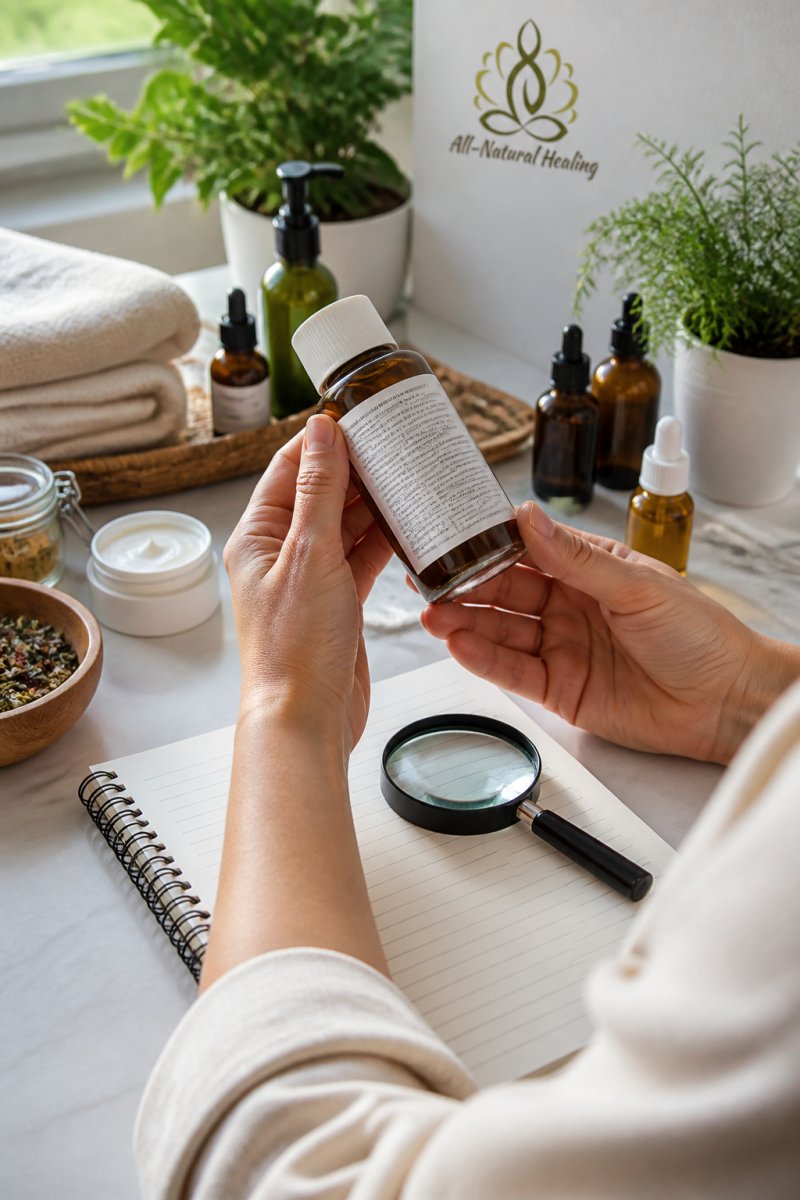
Here is a practical checklist for evaluating any product:
- Scan the first five ingredients for the base formula
- Circle any fragrance, essential oil, or botanical extract you have reacted to before
- Check for preservatives; their absence in a water-based product is a red flag
- Look for "fragrance" as a catch-all term, which can hide dozens of compounds
- Verify any "natural" claim against the actual ingredient list
For sensitive skin, patch testing is the only way to confirm tolerability before full use.
Patch Testing Protocols for Reactive Skin
Patch testing is the process of applying a small amount of product to a controlled area of skin and monitoring for a reaction before using it widely. For reactive skin, it is the single most reliable way to avoid a bad reaction.
A standard protocol looks like this:
- Apply a small amount behind your ear or on your inner forearm
- Leave it undisturbed for 24 hours
- Check for redness, itching, or swelling
- Repeat for 2-3 days before applying to your face
- Introduce one new product at a time, never several at once
If a reaction appears, stop use and note the ingredient list. Over time, this builds a personal map of what your skin tolerates.
Environmental Impact vs. Skin Safety: Two Different Questions
Environmental impact and skin safety are separate questions that the natural skincare conversation often conflates. A biodegradable, sustainably sourced ingredient can still be a potent allergen, and a lab-designed ingredient can be both safe for skin and environmentally responsible.
Plant-derived sourcing carries its own footprint: water use, land use, and the concentration required to extract active compounds. Lab-designed ingredients can reduce that footprint while offering a more standardized safety profile. The two goals can align, but they do not automatically.
Conclusion
The honest answer to whether natural skincare is safer is that safety depends on the specific ingredient, its concentration, and your individual skin, not on whether it grew in soil or was made in a lab. The term "natural" carries no legal definition, no standardized testing, and no guarantee of hypoallergenic performance.
If you want products vetted for both authenticity and safety, All-Natural Healing Store curates every item personally through Dr. House, drawing on 30 years of experience in environmentally safe health and nutrition.
Frequently Asked Questions
Does natural mean safer in skincare?
No. Natural and synthetic describe where an ingredient comes from, not how safe it is. Poison ivy is natural; lab-made glycerin is generally well tolerated. The FDA does not review or approve cosmetics before they go on sale, so 'natural' on a label carries no legal weight. What determines safety is the specific ingredient, its concentration, and your own skin's reaction to it.
Are synthetic ingredients always harmful to the skin?
No. Many synthetic ingredients are among the best-studied and gentlest options available. Lab-designed preservatives like phenoxyethanol help prevent microbial contamination that can cause infections, especially in water-based products. Synthetic humectants such as glycerin and hyaluronic acid draw water into the skin without the irritation potential that some botanical extracts carry. The source of an ingredient tells you nothing about its safety profile on its own.
How does the FDA regulate natural skincare products?
The FDA regulates cosmetics under the Federal Food, Drug, and Cosmetic Act, but it does not pre-approve products or ingredients before they reach shelves, with the exception of color additives. The agency can act after a product is marketed if it is misbranded or adulterated. There is no legal definition of 'natural' or 'clean' in cosmetics law, so those terms are marketing language rather than regulated claims.
What are the risks of using unregulated natural beauty products?
The main risks are allergic contact dermatitis from botanical extracts and essential oils, microbial contamination in products preserved only with weak natural alternatives, and unpredictable concentrations of active plant compounds. Fragrance sensitivity is especially common, and 'fragrance-free' labels are not standardized. Patch testing on your inner forearm for 24 to 48 hours before full use is the simplest way to catch a reaction early.


