

Table of Contents
- What Toxin Free Personal Care Actually Means
- How Endocrine Disruptors in Cosmetics Affect Hormonal Health
- How to Read Skincare Ingredient Labels Like a Pro
- Natural Alternatives to Synthetic Fragrances
- Skin Barrier Health and Vitality: What Changes When You Switch
- Budget-Friendly Ways to Transition to Toxin Free Personal Care
- Frequently Asked Questions
Last Updated: September 10, 2026
What Toxin Free Personal Care Actually Means
Toxin free personal care means choosing skincare, hair, and body products formulated without ingredients linked to hormone disruption, irritation, or long-term chemical buildup. At All-Natural Healing Store, we've spent years vetting products for exactly this reason, because the front label rarely tells you what's inside.
The harder question is what "toxin free" actually excludes, because the term isn't regulated. A brand can print "natural" or "clean" without meeting any legal standard, which is why so many shoppers end up frustrated by products that turn out to be marketing dressed up as science.
Most guides treat "toxin free" as a single category when it's really a spectrum. Some products avoid the worst offenders but still lean on synthetic preservatives; others go fully plant-based but sacrifice shelf stability. Knowing where a product falls matters more than the word on the front.
Clean Beauty vs. Chemical-Free: What the Labels Really Say
"Clean beauty" and "chemical-free" are marketing terms, not regulatory ones. The FDA's guidance on cosmetics labeling makes clear that the agency doesn't define or approve these claims, which means the burden falls on you to verify what's actually in the bottle.
A few practical distinctions worth knowing:
- "Chemical-free" is technically impossible. Water is a chemical. What brands usually mean is "free of specific synthetic chemicals they've chosen to exclude."
- "Clean beauty" typically refers to avoiding a brand's own restricted ingredient list, which varies widely from company to company.
- "Non-toxic" has no legal definition in personal care and can mean almost anything.
The takeaway: ignore the front label and read the back. That's where the real story lives.
How Endocrine Disruptors in Cosmetics Affect Hormonal Health
Endocrine disruptors in cosmetics are chemicals that interfere with the body's hormone signaling, potentially affecting everything from thyroid function to reproductive health. The Environmental Working Group's Skin Deep database has documented thousands of personal care ingredients with varying levels of concern, and the pattern is consistent: the ingredients most worth avoiding show up in products people use daily.
Parabens, Phthalates, and Synthetic Fragrances
These three categories are the most common offenders.
Parabens are preservatives that extend shelf life. They're absorbed through the skin and studied for estrogen-mimicking activity. Many brands have removed them, but "paraben-free" products sometimes substitute preservatives with similar concerns.
Phthalates often hide under the catch-all term "fragrance." They make scents last longer and soften plastics in packaging. Because fragrance formulas are trade secrets, one word on the label can represent dozens of unlisted compounds.
Synthetic fragrances are the leading cause of allergic contact dermatitis in skincare, according to dermatology research. If you have sensitive skin, this is the first category to eliminate.
How to Read Skincare Ingredient Labels Like a Pro
Reading skincare ingredient labels comes down to one habit: scanning the first five ingredients, then checking the last five. Ingredients are listed in order of concentration, so the top of the list tells you what you're mostly buying, and the bottom tells you what's present in trace amounts. That ordering rule isn't a blogger convention, it's a labeling requirement enforced by the FDA's cosmetics labeling requirements, which mandates that ingredients be declared in descending order of predominance (with a few exceptions like color additives and ingredients under 1%).
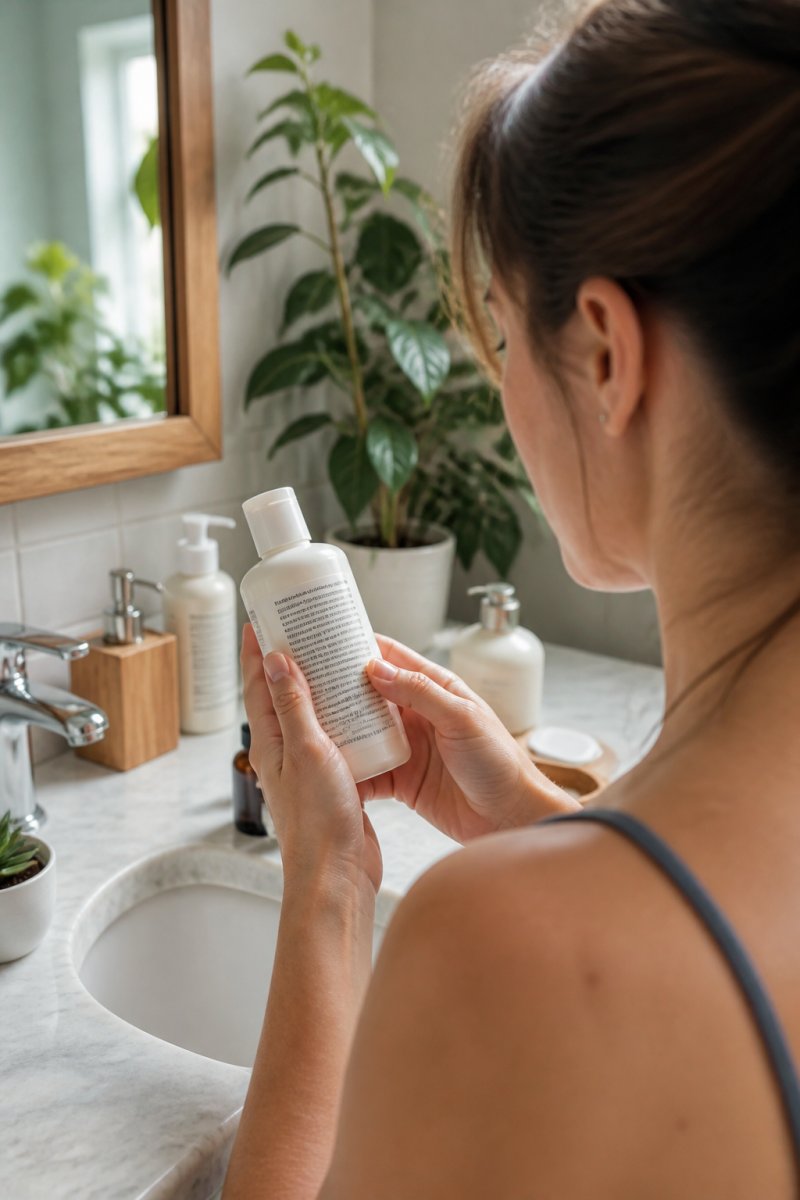
Most people do this backwards, scanning for scary-sounding words anywhere on the list without realizing concentration matters as much as presence. A preservative at 0.1% is a different conversation than the same ingredient at 10%. Since the FDA doesn't require pre-market approval for cosmetic ingredients (except color additives), the label is often your only transparency, read it like a form, not a brochure.
The First Five Ingredients Matter Most
If the first five ingredients are water, alcohol, and synthetic fillers, the product is mostly filler. If they're oils, butters, or plant extracts, you're getting something closer to what the label promises. Water ("aqua") is the most common first ingredient in lotions and cleansers, normal, not a red flag. The red flag is water followed by a long run of synthetic emollients and preservatives before any botanical appears.
A simple label-reading checklist:
- Are the first three ingredients recognizable?
- Does "fragrance" or "parfum" appear anywhere?
- Are parabens (methyl-, propyl-, butyl-) listed?
- Do phthalates appear as "DBP," "DEP," or "DEHP"?
- Is there a preservative system you can identify?
If you can answer these five questions in under a minute, you're ahead of most shoppers.
The Loopholes That Hide Ingredients From You
Three loopholes explain why a label can look clean and still hide something you'd rather avoid:
- "Fragrance" and "parfum" are trade-secret protected. Under the Fair Packaging and Labeling Act, a fragrance mixture can be declared with one catch-all term instead of its components, a word that can represent dozens of unlisted compounds, including phthalates used as fixatives.
- "Inactive" and "other" categories on drug-cosmetic hybrids. Products straddling the cosmetic/drug line, anti-dandruff shampoos, sunscreen, follow different labeling rules and can list ingredients under categories that obscure what's present.
- "Natural" has no legal definition in cosmetics. The FDA has not defined "natural" for cosmetic labeling and doesn't object to its use as long as it isn't misleading, a very low bar. "Clean," "non-toxic," and "green" sit in the same unregulated bucket.
Treat the front label as advertising and the back label as your only semi-reliable disclosure. When a brand hides behind "fragrance," look for a fragrance-free alternative or a brand that discloses its full scent composition.
A Worked Example: Two Moisturizers, Same Shelf
Imagine two moisturizers side by side. The first lists: water, glycerin, cetearyl alcohol, shea butter, jojoba oil, fragrance, methylparaben, propylparaben. The second lists: water, glycerin, cetearyl alcohol, shea butter, jojoba oil, lavender oil, tocopherol, sodium benzoate.
The first has a fragrance catch-all (possible phthalates) and two parabens. The second uses a named essential oil and a recognizable preservative. Neither is automatically "safe", lavender oil can trigger reactions, and sodium benzoate is still synthetic, but you can research every ingredient in the second list. That's the difference between a label you can audit and one you have to trust.
Natural Alternatives to Synthetic Fragrances
Natural alternatives to synthetic fragrances come from essential oils, plant extracts, and botanical distillates, and they work differently: they fade faster, interact with skin chemistry, and carry their own allergy potential. That's not a reason to avoid them, but a reason to test before committing.
The shift from synthetic to natural scent isn't just about avoiding phthalates. It's about knowing what you're putting on your skin. A lavender essential oil is a single compound you can research. "Fragrance" on a label is a black box.
For people with sensitive skin, the safest approach is fragrance-free rather than naturally scented. Even plant-based scents can trigger reactions in some skin types.
Skin Barrier Health and Vitality: What Changes When You Switch
Skin barrier health often improves within two to four weeks of switching to toxin free personal care, though the timeline varies by skin type and how many products you replace. The barrier is your skin's outermost layer, doing two jobs: keeping moisture in and irritants out. When synthetic ingredients compromise it, you get dryness, redness, and reactivity.
What changes when you switch:
- Less reactivity. Fewer synthetic irritants means fewer flare-ups.
- Better moisture retention. Natural oils and butters tend to support the barrier rather than strip it.
- More consistent tone. Reduced inflammation shows up as calmer skin over time.
Coming from a conventional routine, expect a transition period: some people see improvement in days, others need a full skin cycle (roughly 28 days) before the difference is obvious.
For a simple starting point, All-Natural Healing Store carries tallow-based cleansers and balms formulated without synthetic fragrance or parabens. The Forge Tallow Shaving & Face Wash uses grass-fed beef tallow as its base, which closely mirrors the lipids your skin already produces. That's the kind of formulation that supports barrier health instead of fighting it.

Budget-Friendly Ways to Transition to Toxin Free Personal Care
A full toxin free personal care overhaul costs more than people expect if you replace everything at once. Prioritize by absorption and frequency of use, then spread the switch over three to six months. Most guides frame clean beauty as a luxury upgrade; a thoughtful transition can cost roughly the same as a conventional routine once you factor in cost-per-use and stop buying products that don't work for your skin.
Prioritize in this order:
- Products you leave on. Moisturizers, serums, and body lotions sit on your skin for hours.
- Products you use daily. Cleansers and deodorants.
- Products you rinse off quickly. Shampoo and body wash matter less because contact time is short.
For most people, replacing three products covers the majority of daily chemical exposure. You don't need to throw everything out on day one.
The Cost-Per-Use Reframe
A common mistake is comparing sticker prices between a conventional and a clean product. Compare cost per use instead: a concentrated balm or bar lasting three months often costs less per application than a watery lotion you replace every three weeks. Multi-tasking products, a cleanser that also removes makeup, a balm for face and hands, cut the number of items you buy, which is where the real savings live. Refill programs and larger sizes also lower per-ounce cost over time.
Five Budget-Friendly Transition Strategies
- Replace one product per pay period. Spreading purchases over three to six months avoids a single large outlay and lets you test each product before buying the next.
- Start with a multi-tasking balm or bar. A single tallow-based balm can replace a moisturizer, an overnight mask, and a cuticle cream. Fewer products, fewer dollars.
- DIY the low-risk items. Sugar-and-oil scrubs, oatmeal cleansers, and simple oil blends are inexpensive and easy to verify because you control every ingredient. Skip DIY for anything that needs preservation (water-based products), those can grow bacteria without a proper preservative system.
- Use refill and take-back programs. Several clean beauty brands now offer refillable packaging or in-store take-back for empties, which lowers cost and waste at the same time.
- Buy fragrance-free, not just "clean." Fragrance-free products are often cheaper than naturally scented ones because they skip the scent formulation entirely, and they're the safer choice for sensitive skin anyway.
What to Do With the Products You're Replacing
Most guides tell you to switch but skip the disposal question. Don't pour lotions, serums, or cleansers down the drain, many contain ingredients hard on aquatic life, and some (microbeads, certain preservatives) are specifically flagged for environmental harm. Instead:
- Use them up on your body or hands if they don't irritate your skin, rather than wasting them.
- Donate unopened, unexpired products to local shelters or community organizations that accept personal care items.
- Check municipal household hazardous waste guidance for anything with active ingredients (sunscreens, anti-dandruff treatments, medicated creams), which often shouldn't go in the trash or drain.
- Recycle the packaging according to your local rules, many curbside programs accept rigid plastic bottles but not pumps or aerosol cans.
Thoughtful disposal closes the loop: you reduce your own exposure and avoid shifting the chemical burden to the environment.
Where a Simple Routine Fits In
The FORGE SKIN® Wrinkle Defense Beef Tallow is a good example of a leave-on product that does double duty: it hydrates and supports the barrier without a long ingredient list. If you want to add a serum step, the FORGE SKIN Beef Tallow Serum pairs well with it for evening use. Both fit the cost-per-use logic, a little goes a long way, and one jar replaces several conventional products.


One more thing worth mentioning: if you deal with chronic congestion or breathing issues at night, Dr. House's nasal clip for sleep apnea and snoring is designed to support nasal breathing by clearing mucus in the nasal passages and nasopharynx. It's a natural, non-pharmaceutical option that fits the same philosophy as the rest of the store's catalog.
Frequently Asked Questions
What are the main benefits of using toxin free personal care products?
Switching to toxin free personal care reduces your exposure to ingredients like parabens, phthalates, and synthetic fragrances that can accumulate in your body over time. Many people report calmer skin, fewer allergic reactions, and more stable energy levels. Because your skin absorbs a portion of what you apply, choosing products with recognizable ingredients supports your skin barrier, hormonal balance, and overall wellness. It also helps reduce indoor air pollution from volatile organic compounds released by conventional products.
How do endocrine disruptors in cosmetics affect hormonal health?
Endocrine disruptors in cosmetics, such as parabens and phthalates, can mimic or interfere with your body's natural hormones. Research links repeated exposure to these chemicals with thyroid changes, reproductive health concerns, and altered estrogen activity. Because you apply personal care products daily, small exposures add up through a process called bioaccumulation. Choosing products free from these ingredients lowers your toxic load and supports hormonal balance over time.
What ingredients should I avoid in my daily personal care routine?
Watch for parabens, phthalates, formaldehyde releasers, sulfates, and synthetic fragrances on ingredient lists. These are common in conventional shampoos, lotions, and deodorants. Also check for vague terms like 'fragrance' or 'parfum,' which can hide dozens of undisclosed chemicals. When you learn how to read skincare ingredient labels, you can spot these quickly. Prioritize products with short, recognizable ingredient lists and third-party certifications when possible.
Are toxin-free products as effective as conventional beauty products?
Yes, when formulated well. Many toxin-free products use ingredients like beef tallow, plant oils, and essential oils that hydrate and nourish skin effectively. The key difference is what they leave out, not what they lack in performance. Some people find natural products work better for sensitive skin because they skip harsh preservatives and synthetic fragrances. Results vary by skin type, so patch-test new products and give them a few weeks before judging.


