


Table of Contents
- What You'll Need to Start Reducing Modern Pollutants
- Step 1: Check Your Air Quality Index and Plan Outdoor Time
- Step 2: Indoor Air Quality Improvement Tips for Every Room
- Step 3: How to Reduce Exposure to Endocrine Disruptors at Home
- Step 4: Filter Your Water to Remove Particulate Matter and VOCs
- Step 5: Reduce Microplastic Exposure in Your Daily Routine
- Common Mistakes to Avoid When Reducing Pollutant Exposure
- Conclusion
- Frequently Asked Questions
Last Updated: September 11, 2026
What You'll Need to Start Reducing Modern Pollutants
Avoiding modern pollutants in daily life starts with a simple shift: treat your home, your water, and your daily products as a system, not a checklist. This guide from All-Natural Healing Store walks through five practical steps, from checking your local air quality index to filtering what you drink and breathe. None of it requires a renovation or a second income.
Modern pollutants are the airborne, chemical, and particulate contaminants that have entered everyday environments since the mid-twentieth century: vehicle exhaust, volatile organic compounds from household products, microplastics, and industrial particulate matter. The Environmental Protection Agency's air quality guidance notes that indoor pollutant levels can run higher than outdoor levels because enclosed spaces concentrate whatever enters them.
Here's what the standard advice gets wrong: people chase one fix, usually an air purifier, and ignore the sources feeding the problem. The steps below work in order, and each one builds on the last.

Total Time: 2-3 hours to set up, then a few minutes daily Difficulty: Beginner
What You'll Need:
- Your local air quality index source (weather app or government site)
- One air purifier sized to your main living space
- A water filter rated for VOCs and particulate matter
- Fragrance-free cleaning and personal care products
- Reusable glass or stainless steel containers
Step 1: Check Your Air Quality Index and Plan Outdoor Time
The air quality index is a 0-500 scale that reports how polluted the air currently is, with higher numbers signaling greater health risk. The Environmental Protection Agency's air quality index guidance breaks the scale into six color-coded categories, and knowing where your day falls changes what's safe to do outside.
- 0-50 (Good): no precautions needed for most people
- 51-100 (Moderate): unusually sensitive individuals should watch for symptoms
- 101-150 (Unhealthy for Sensitive Groups): children, older adults, and people with asthma or heart conditions should limit prolonged outdoor exertion
- 151-200 (Unhealthy): everyone should reduce prolonged or heavy outdoor exertion
- 201-300 (Very Unhealthy): everyone should avoid outdoor exertion; sensitive groups stay indoors
- 301-500 (Hazardous): stay indoors, seal windows, run filtration
Checking the index takes ten seconds and changes how you plan your day. On days when the index runs above 100, shift your run, your dog walk, or your commute to early morning or evening.
Why Timing Matters More Than You Think
Different pollutants peak at different hours, so the same index number can mean different things depending on what's driving it.
- Ozone forms when sunlight reacts with vehicle and industrial emissions, so it peaks in the afternoon and early evening on hot, sunny days. Morning is meaningfully cleaner.
- Fine particulate matter (PM2.5) from traffic, wood smoke, and industrial sources often peaks during morning and evening rush hours, then settles overnight. If you're in a traffic-heavy area, midday can be cleaner than dawn.
- Wildfire smoke doesn't follow a daily curve. It moves with wind and can spike within an hour, which is why checking twice daily matters more than checking once.
Keep windows closed on high-index days and open them when numbers are low. A common mistake is airing out the house during a wildfire smoke event because it "feels stuffy," which pulls fine particulate matter straight into your living room and deposits it on surfaces where it re-suspends for days.
Matching Activity to Air Quality
Not every outdoor activity carries the same exposure. The harder you breathe, the deeper pollutants travel into your lungs.
- Running, cycling, or HIIT outdoors: highest exposure, move indoors or reschedule when the index exceeds 100
- Walking, gardening, light yard work: moderate exposure, fine for most people up to 150
- Commuting on foot or by bike: route away from arterial roads; side streets can cut traffic-related exposure substantially
- Kids' outdoor play: children breathe more air per pound of body weight, so treat them as a sensitive group at 101+
If you must be outside on a high-index day, a well-fitted N95 or KN95 respirator filters fine particulate matter, though it does not block gases like ozone. For ozone, timing is the only real defense.
Step 2: Indoor Air Quality Improvement Tips for Every Room
Indoor air quality improvement tips work best when you match the fix to the room. Bedrooms need quiet filtration, kitchens need ventilation at the source, and living areas need both.
Start with ventilation. Run your range hood every time you cook, even for a quick scramble. Gas stoves release nitrogen dioxide and fine particulate matter directly into the kitchen, and the hood is the only thing standing between that plume and your lungs.
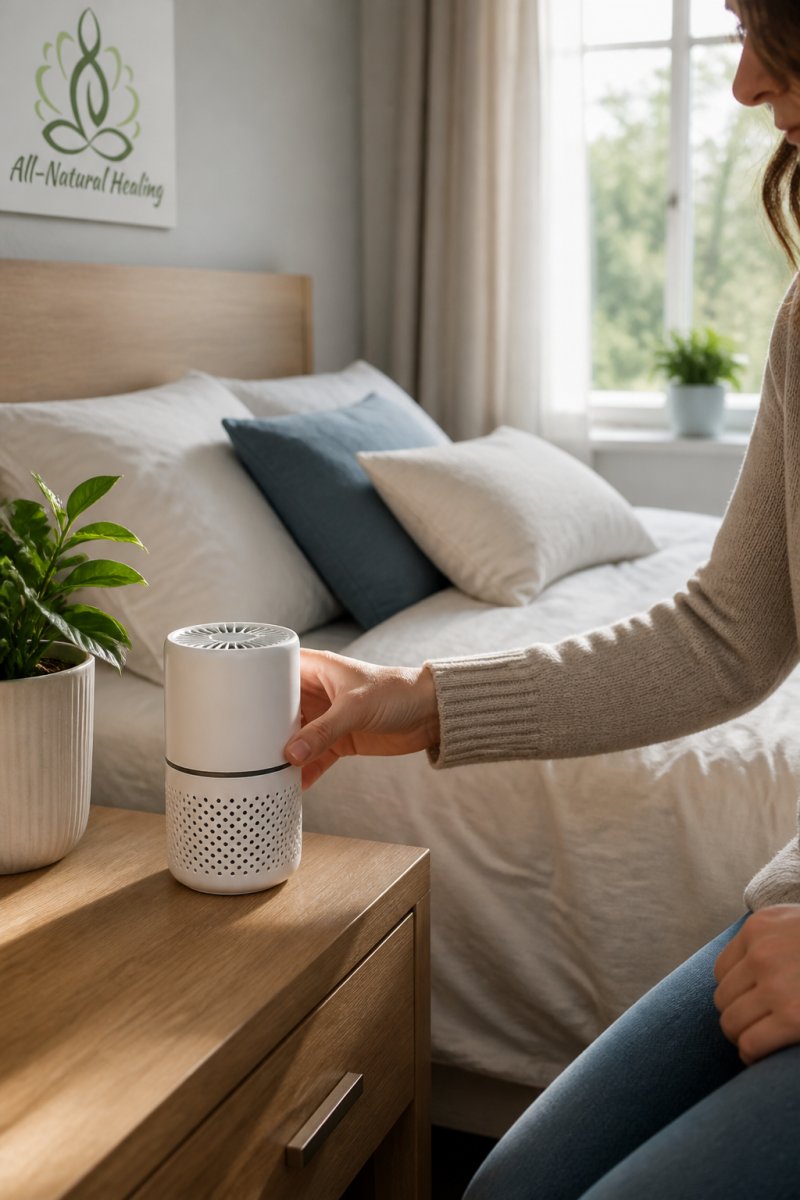
Then add filtration. An ionizer-style purifier works without a fan, which matters in bedrooms where motor noise keeps people awake. The Ionic Pro CA200 air purifier covers rooms up to 200 square feet and captures dust, pollen, pet dander, and smoke particles without a filter to replace.
For smaller spaces, a plug-in unit handles a bathroom or home office. The mini plug-in ionizer runs at roughly 20 decibels and covers about 280 square feet, which makes it a reasonable fit for a kitchen or pet room.
Choosing the Right Air Purifier for Your Space
Choosing the right air purifier comes down to three numbers: room size, noise level, and whether you'll actually maintain it. A unit that's too small for the room does almost nothing.
- Under 200 sq ft (bedroom, office): compact tower or plug-in ionizer
- 200-400 sq ft (living room): larger tower or two plug-ins
- Kitchen: ventilation first, filtration second
- Pet areas: ionizer rated for dander and odor
Filter-based purifiers trap particles; ionizers charge them so they settle out of the air. Ionizers win on noise and maintenance, which is why they tend to stay plugged in. A purifier sitting in a closet helps no one.
Step 3: How to Reduce Exposure to Endocrine Disruptors at Home
Learning how to reduce exposure to endocrine disruptors begins with reading labels, because these chemicals hide in products you touch daily. Endocrine disruptors are substances that interfere with hormone signaling by mimicking, blocking, or altering how natural hormones work in the body. They show up in plastics, fragrances, nonstick coatings, and the linings of canned food.
The Chemicals Worth Knowing by Name
Generic "avoid toxins" advice is useless without specifics. These are the ones most commonly found in household products, along with where they hide:
- Phthalates: used to soften plastic and carry fragrance. Found in scented candles, air fresheners, vinyl flooring, and personal care products listing "fragrance" or "parfum" on the label.
- Bisphenols (BPA and its replacements): used in polycarbonate plastics and can linings. Found in some reusable water bottles, food storage containers, and canned goods. "BPA-free" often means a structurally similar substitute.
- PFAS (per- and polyfluoroalkyl substances): used for stain and grease resistance. Found in nonstick cookware, waterproof clothing, microwave popcorn bags, and some food packaging.
- Parabens: preservatives in lotions, shampoos, and cosmetics.
- Triclosan: an antibacterial agent in some soaps and toothpaste.
The biggest offenders in most homes are synthetic fragrances and volatile organic compounds. Scented candles, air fresheners, and "spring breeze" laundry detergent all release VOCs into the air you breathe. Swap them for unscented or naturally scented alternatives. The EPA's guidance on volatile organic compounds explains that VOC concentrations indoors can be several times higher than outdoors, largely because of these consumer products.
Swapping Household Products That Contain Harmful Chemicals
Swapping household products that contain harmful chemicals doesn't mean replacing everything at once. Replace each item as it runs out, which spreads the cost and keeps the change sustainable.
- Cleaning sprays: switch to vinegar-based or fragrance-free options
- Air fresheners: open a window or use an ionizer instead
- Plastic food storage: move to glass or stainless steel
- Nonstick cookware: replace scratched pans with cast iron or ceramic
- Personal care: choose fragrance-free lotions and soaps
- Canned goods: favor fresh, frozen, or glass-jarred alternatives when practical
One mechanism worth understanding: heat accelerates the migration of phthalates and bisphenols out of plastic and into food. That's why "don't microwave in plastic" is repeated so often, it's not a slogan, it's chemistry. The same logic applies to hot liquids in plastic cups and hot food in plastic takeout containers.
The Mental Health Side Nobody Talks About
Here's the part most guides skip entirely: the psychological cost of trying to avoid everything. Constant vigilance about what's in your air, water, food, and furniture can tip into what researchers and clinicians call eco-anxiety, a persistent, low-grade dread about environmental exposure that paradoxically makes people freeze rather than act.
A few patterns help:
- Pick your battles by exposure frequency, not by fear. The products you use daily (cookware, water bottle, cleaning spray) matter more than the ones you touch twice a year.
- Set a "good enough" threshold. Perfect avoidance isn't achievable in a modern home. Reducing the biggest sources by 80% captures most of the benefit.
- Avoid doom-scrolling chemical-exposure content. Reading more studies without a plan increases anxiety without changing exposure.
- Replace, don't obsess. Each swap you complete is one less thing to think about. Progress reduces mental load; perfection increases it.
The goal is a home that's meaningfully cleaner than the average, not a home that's sterile. Sustainable habits beat heroic ones every time.
Step 4: Filter Your Water to Remove Particulate Matter and VOCs
Filtering your water removes the particulate matter and volatile organic compounds that municipal treatment doesn't fully address. Treatment plants disinfect water and meet safety standards, but they don't strip every contaminant before it reaches your tap.
A countertop unit is the easiest starting point. The V-5 countertop water filter uses a multi-stage, dual-chamber design that increases contact time with the filtration media, targeting sediment, particulate matter, and VOCs across a 5,000-gallon capacity. If counter space is tight, the undercounter version installs below the sink and runs on the same filtration approach.


Change your filter on schedule. A saturated filter stops removing contaminants and can start releasing what it captured.
Step 5: Reduce Microplastic Exposure in Your Daily Routine
Reducing microplastic exposure comes down to cutting contact between plastic and things you consume. Microplastics are fragments smaller than five millimeters that shed from packaging, synthetic fabrics, and containers, and they've been found in drinking water and household dust.
Three changes move the needle fastest:
- Stop heating food in plastic containers, which accelerates shedding
- Switch from plastic water bottles to glass or stainless steel
- Choose natural-fiber clothing over synthetic where practical
Microplastic exposure is one of the areas most guides skip entirely, and it's also one of the easiest to reduce. The swap costs almost nothing if you do it gradually.
Common Mistakes to Avoid When Reducing Pollutant Exposure
The most common mistakes when reducing pollutant exposure all share a root cause: treating symptoms instead of sources. Here are the ones worth avoiding.
- Buying a purifier before checking the index. Without knowing when air is bad, you can't plan around it.
- Running a purifier with windows open on a high-index day. You're filtering outdoor air as fast as it enters.
- Replacing everything at once. Most people burn out and revert within a month.
- Ignoring the kitchen. Cooking generates some of the highest indoor particulate levels in the home.
- Forgetting water. Air gets all the attention; tap water carries its own particulate load.
Conclusion
Modern pollutants are cumulative, and so are the small changes that reduce them. You don't need a perfect home, just a system that catches most of what's coming in.
All-Natural Healing Store vets every product through Dr. House, drawing on 30 years in the environmentally safe health and nutrition industry, so you're not guessing which purifier or filter actually performs. The Ionic Pro CA200, the plug-in ionizer, and the V-5 water filtration line cover the three biggest exposure points in most homes: air, water, and the products you touch. For anyone whose sleep is disrupted by breathing issues rather than pollutants alone, the Dr. Holistic's Nasal Clip for Sleep Apnea is a nasal clip designed to make nasal breathing easier by clearing mucous in the nasal passages and nasopharynx.
Get started with All-Natural Healing Store and build a daily routine that keeps modern pollutants out of your body.
Frequently Asked Questions
What are the most common indoor air pollutants to avoid?
Common indoor air pollutants include particulate matter from cooking and candles, volatile organic compounds (VOCs) off-gassing from furniture and paints, synthetic fragrances from cleaning products and air fresheners, and biological contaminants like mold and dust mites. Reducing these sources through proper ventilation, choosing fragrance-free products, and using an air purifier can significantly lower your daily exposure.
How can I reduce my exposure to microplastics in daily life?
Switch from plastic food storage containers to glass or stainless steel, avoid single-use plastic water bottles, choose natural fiber clothing over synthetic fabrics, and never heat food in plastic containers. These changes reduce both ingestion and inhalation of microplastic particles. Small consistent swaps add up to meaningful exposure reduction over time.
What household products contain the most harmful chemicals?
Air fresheners, conventional cleaning sprays, non-stick cookware, synthetic fragrances, and vinyl products like shower curtains are among the biggest sources of chemical exposure at home. Checking ingredient labels and choosing fragrance-free, plant-based alternatives can cut your exposure to endocrine disruptors and volatile organic compounds substantially.
What are the best ways to filter water at home?
Countertop and undercounter water filtration systems with multi-stage media effectively reduce sediment, volatile organic compounds, and other contaminants. Look for systems that address particulate matter and chemical contaminants rather than simple carbon pitcher filters. Regular filter replacement and back-flushing maintain performance over the system's lifespan.


