

Table of Contents
- What Doctor Vetted Herbal Remedies Actually Change for You
- Herbal Medicine and Prescription Drug Interactions: The Risk Nobody Screens For
- How to Identify High-Quality Herbal Supplements Before You Buy
- Evidence-Based Herbal Medicine Practices: What Clinical Research Supports
- Personalized Herbal Safety: Why Your Body Needs Its Own Assessment
- Sustainability and Sourcing: Where Vetted Remedies Come From
- Frequently Asked Questions
Last Updated: September 12, 2026
What Doctor Vetted Herbal Remedies Actually Change for You
Doctor vetted herbal remedies are botanical products that a qualified medical professional has reviewed for purity, dosage, interactions, and sourcing before they reach your hands. At All-Natural Healing Store, every product in our catalog is personally reviewed by Dr. House, known as Dr. Holistic, who brings 30 years of experience in the environmentally safe health and nutrition industry.
The difference between a vetted remedy and a random bottle from a shelf comes down to one word: accountability. Someone with clinical training has already asked the questions you would not know to ask.
Below, we break down what that review process catches, where it falls short, and how to apply the same standards when you shop anywhere.
Herbal Medicine and Prescription Drug Interactions: The Risk Nobody Screens For
The biggest danger with herbal medicine and prescription drug interactions is that nobody screens for them at the point of sale. A clerk at a supplement shop cannot tell you whether your blood thinner conflicts with what you just picked up. Your pharmacist may not ask, because herbal products sit outside the standard medication review.
Which Herbs Interact With Common Prescriptions
Certain botanical categories carry well-documented interaction risks. Herbs with blood-thinning properties can compound the effect of anticoagulant therapy. Herbs that affect liver enzymes can change how quickly your body clears other medications. Sedative herbs can deepen the effect of sleep aids or anti-anxiety prescriptions.
The practical rule: any herb that changes how your blood clots, how your liver processes drugs, or how alert you feel deserves a conversation with a clinician before you start it.
How a Vetting Process Catches Interactions Before You Do
A proper vetting process flags contraindications at the product level. Our Cinnamon & Poria Teapills, for example, carry an explicit contraindication for pregnancy and a caution for anyone on anticoagulant therapy or managing a hemorrhagic disorder. That information sits on the label because a reviewer put it there.

That is the whole point. You should not have to reverse-engineer a safety profile from a vague ingredient list.
How to Identify High-Quality Herbal Supplements Before You Buy
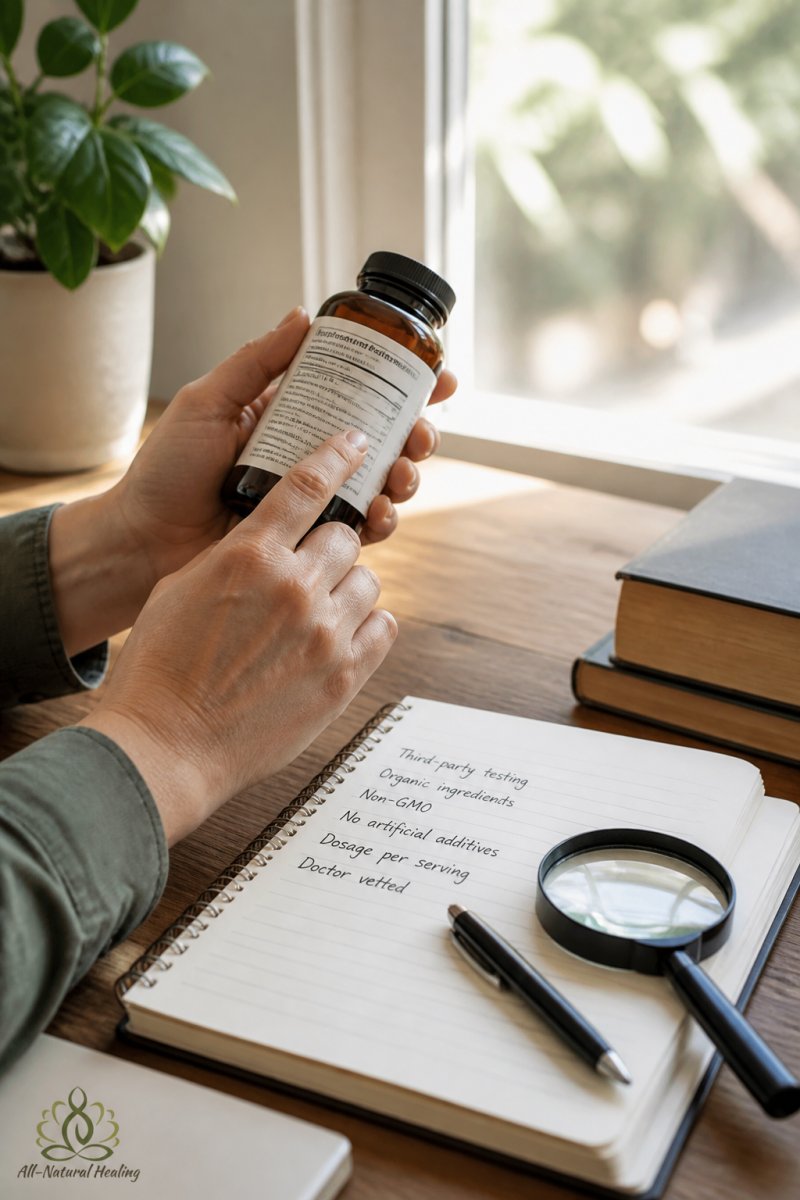
The fastest way to identify a high-quality herbal supplement is to check four things: a standardized extract or named botanical source, a complete contraindication and allergen statement, third-party testing or certification, and a manufacturer willing to name itself.
The Third-Party Verification Marks That Actually Mean Something
Most articles tell you to "look for third-party testing" and stop there. Here is what the specific marks mean, so you can tell a real verification from a logo someone paid to print.
- USP Verified Mark. The United States Pharmacopeia runs an independent verification program. A product carrying the USP Verified Mark has been audited for the ingredients listed on the label, potency, and that it does not contain harmful levels of specified contaminants. It also confirms the product will break down in the body within a set time so the ingredients are actually available for absorption.
- NSF Certified for Sport and NSF Contents Certified. NSF International tests for label claims, contaminants, and, in the sport program, substances banned in athletic competition. The sport mark is the one to look for if you are subject to drug testing.
- ConsumerLab.com. A subscription testing service that buys products off the shelf and publishes pass/fail results. It is not a mark on the bottle, but it is one of the few independent sources that names specific brands and batches.
- GMP compliance. "Manufactured in a GMP-certified facility" refers to Good Manufacturing Practices, the FDA's requirements for how supplements are made, packaged, and held. It speaks to process, not to whether the herb in the bottle is what the label says. Treat it as a floor, not a ceiling.
A product can carry a GMP claim and still fail a potency test. The verification marks above are the ones that test the finished product, not just the factory.
Run Every Product Through This Checklist
- Does the label name the exact botanical (genus and species) and the plant part used?
- Is there a standardized extract percentage or a stated marker compound?
- Are contraindications, allergens, and drug cautions printed on the label, not buried online?
- Is there a batch or lot number that ties to a test result?
- Does the maker list a real address and a way to reach a human?
- Is the packaging material disclosed if sustainability matters to you?
A "yes" on all six is rare. Two or three is typical. The gaps tell you what you are actually buying.
| Checkpoint | What Weak Products Show | What Vetted Products Show |
|---|---|---|
| Botanical source | "Herbal blend" | Named species and plant part |
| Potency | Unstated | Standardized extract or marker compound |
| Safety notes | None printed | Contraindications and allergen list |
| Traceability | No lot number | Batch number tied to testing |
| Maker identity | Post office box | Named company, reachable support |
| Verification | No third-party mark | USP Verified, NSF, or published test result |
Why the Label Is the Only Document You Can Trust at the Shelf
The FDA regulates dietary supplements as a category of food, not as drugs (the FDA). That means the agency does not review a product for safety and effectiveness before it is sold, and it does not approve the claims on the label (the FDA). The manufacturer is responsible for making sure the product is safe and that the label is truthful. When a product is found to be adulterated or misbranded, the FDA can act after the fact.
That is the entire reason third-party verification and a named, reachable maker matter. In a category where pre-market review does not happen, the label and the testing behind it are the only accountability you have before you swallow something.
A "yes" on all six checklist items, plus a real verification mark, is what separates a product someone stood behind from a product someone shipped.
Evidence-Based Herbal Medicine Practices: What Clinical Research Supports
Evidence-based herbal medicine practices separate botanicals with real clinical trial backing from those carried only by tradition. Some herbs have decades of controlled research behind them. Others have centuries of use and almost no formal study.
That gap matters when you are choosing what to take for a specific concern. A remedy with trial data gives you a reasonable expectation of effect and a known side-effect profile. A remedy with only traditional use gives you a starting point, not a guarantee.
The honest position is that both categories have value, and neither replaces a diagnosis. If you are managing a chronic condition, herbal support works alongside your care, not instead of it. The FDA's guidance on dietary supplements explains how these products are regulated and why label accuracy varies so widely.
Our 8 Flavor Rehmannia Teapills and Emperor's Teapills both carry the same plain disclaimer: individual results vary, and the product is not intended to diagnose, treat, cure, or prevent any disease. That language is not a weakness. It is what honest labeling looks like.

Personalized Herbal Safety: Why Your Body Needs Its Own Assessment
Personalized herbal safety means matching a remedy to your medications, allergies, pregnancy status, and existing conditions, not to a generic recommendation. Two people can take the same herb and have completely different outcomes.
This is the angle most buying guides skip entirely. They list benefits and move on. They do not ask whether you are on a blood thinner, whether you are pregnant or postpartum, or whether you have a tree nut allergy. Below is a method you can actually run at home before you open the bottle.
A Four-Step Cross-Reference You Can Do Yourself
Step 1: List every medication, including over-the-counter drugs. Write down prescriptions, daily aspirin, NSAIDs like ibuprofen or naproxen, and any other supplement you already take. The interaction risk is not herb-versus-drug in isolation. It is the total load.
Step 2: Flag the herb's known mechanism. Most clinically significant herb-drug interactions run through a small number of pathways. Ask which one applies:
- Blood clotting. Herbs with antiplatelet or anticoagulant activity can compound the effect of warfarin, direct oral anticoagulants, aspirin, and NSAIDs. Ginkgo, garlic, ginger, ginseng, and dong quai are commonly cited in this group. If you bruise easily or are already on a blood thinner, this is the first thing to check.
- Liver enzyme activity. Some botanicals change how fast the liver clears other drugs through the cytochrome P450 system. St. John's wort is the best-documented example and can reduce the effectiveness of many prescriptions, including certain antidepressants, oral contraceptives, and transplant medications.
- Sedation. Valerian, kava, and chamomile can deepen the effect of sleep aids, anti-anxiety drugs, and alcohol.
- Blood sugar and blood pressure. Herbs marketed for metabolic support can push glucose or pressure lower when combined with prescription medication for the same condition.
Step 3: Match against your conditions. Pregnancy and postpartum, bleeding disorders, liver disease, kidney disease, autoimmune conditions, and upcoming surgery all change the risk calculus. Many products carry an explicit contraindication for pregnancy for a reason.
Step 4: Bring the list to a clinician or pharmacist. This is the step most people skip and the one that matters most. A pharmacist can run a formal interaction check against your full medication list in minutes. Most will do it at no charge.
How a Vetted Catalog Does This Work For You
We do. Our Free & Easy Wanderer Teapills carry a caution for use during pregnancy or postpartum and for anyone with a hemorrhagic disorder or on anticoagulant therapy. Our Cinnamon & Poria Teapills note that they contain peach kernel and tree nuts. Our Cinnamon & Poria Teapills note that they contain peach kernel and tree nuts. Those details exist so you can make a decision with your clinician, not after a reaction.

That is the difference between a product that has been through a safety review and one that has not. The contraindication line is not legal boilerplate. It is the output of someone asking the four questions above on your behalf, before the product reached the shelf.
When to Stop and Call a Professional
Stop and consult a healthcare provider before starting any herbal product if you are pregnant, breastfeeding, or trying to conceive; if you take a blood thinner or have a bleeding disorder; if you are scheduled for surgery within two weeks; if you have liver or kidney disease; or if you take a prescription with a narrow safety margin, such as a transplant drug, thyroid medication, or an anticoagulant. In those situations, the herb is not the decision. The conversation with your clinician is.
Sustainability and Sourcing: Where Vetted Remedies Come From
Sustainability and sourcing determine whether a remedy is safe for you and defensible for the planet. A botanical's origin affects its potency, its contamination risk, and the ecosystem it came from.
Sourcing questions worth asking any seller:
- Where is the raw botanical grown or wildcrafted?
- Is the supply chain traceable to a specific farm or cooperative?
- Are heavy metals, pesticides, and microbial contaminants tested per batch?
- Is the packaging recyclable, refillable, or plastic-free?
A seller who cannot answer the first two questions usually cannot answer the last two either. Traceability and testing travel together.
This is where a curated catalog does real work. Rather than stocking hundreds of SKUs and hoping, a vetted selection means every item has already cleared the sourcing conversation. Our Dr. Holistic's nasal clip for sleep apnea reflects the same principle applied to a device: clear the airway, support nasal breathing, and let the body do what it already knows how to do.
The real challenge with herbal remedies is not finding them. It is knowing which ones have been checked by someone qualified to catch what you would miss. All-Natural Healing Store exists to close that gap. Every product is personally vetted by Dr. House, backed by 30 years in the environmentally safe health and nutrition industry, and selected for authenticity, safety, and protection from modern pollutants. Start with our curated herbal collection and shop with the confidence that a clinician already did the homework.
Frequently Asked Questions
Do doctor vetted herbal remedies interact with prescription medications?
Yes, and that is exactly why vetting matters. Herbs such as St. John's wort can speed up how the liver clears certain drugs, while others can add to the effects of blood thinners. A doctor reviews your full medication list before recommending anything, checking for herbal medicine and prescription drug interactions that could reduce how well your prescriptions work or cause adverse reactions. Never assume a natural product is automatically safe to combine with what you already take.
How can I distinguish between high-quality herbal supplements and unregulated products?
Look for a standardized extract that lists the active compounds and their amounts, a third-party certification seal, and a Certificate of Analysis you can request. Reputable sellers disclose the botanical name, plant part used, and batch testing for heavy metals and pesticides. Products that only say 'herbal blend' without amounts, or that make disease treatment claims, are worth skipping. Professional oversight adds a second layer because someone qualified has already reviewed the sourcing and testing.
How long does it take to see results from herbal supplements?
It depends on the herb and what you are addressing. Some people notice changes in sleep or digestion within one to two weeks, while remedies aimed at systemic inflammation or immune modulation often take four to eight weeks of consistent use. Traditional Chinese Medicine formulas, for example, are typically taken in structured courses rather than single doses. Track your response in a simple log and review it with your practitioner, since individual metabolism and dosage guidelines affect timing.
Why is it important to have herbal remedies vetted by a medical professional?
Vetting catches three things self-selection misses: contraindications for your specific health conditions, interactions with prescriptions, and product quality problems like contamination or mislabeling. A doctor also weighs whether an herb fits your situation at all, since some conditions need conventional care first. That combination of personalized herbal safety and verified sourcing is what separates doctor vetted herbal remedies from products chosen off a shelf based on marketing alone.


