

Table of Contents
- What Does Green Marketing in Beauty Actually Promise?
- How to Spot Greenwashing in Skincare Before You Buy
- Understanding the FTC Green Guides for Beauty Products
- Third-Party Certifications for Sustainable Cosmetics to Trust
- Label Claims vs. Real Proof: Reading Beyond the Marketing
- The Missing Angle: Ingredient Toxicity vs. Sustainability
- Your Green Beauty Shopping Checklist
- Conclusion: Trust Your Eyes, Not the Slogans
- Frequently Asked Questions
Last Updated: September 4, 2026
Walk into any beauty aisle in 2026 and you will see the same promise repeated across hundreds of bottles: "clean," "green," "eco-friendly," and "sustainable." Identifying green marketing in beauty products has become essential because the term itself carries no legal weight. Green marketing is the practice of promoting products based on their environmental benefits, from biodegradable packaging to ethically sourced ingredients.

Below, we will show you exactly how to spot the difference before you buy. You will learn the specific tactics brands use to exaggerate their eco-credentials, the regulatory framework that governs these claims, and a practical checklist you can carry into any store.
What Does Green Marketing in Beauty Actually Promise?
Green marketing in beauty products makes a straightforward promise: this item is better for the planet than the conventional alternative. That claim can rest on several different pillars, and knowing which pillar a brand leans on tells you what to investigate.
A brand that says "made with natural ingredients" is making a far weaker statement than one that says "certified organic by USDA." The first describes a single component; the second describes a verified standard. Always ask which specific promise is being made and what proof backs it up.
How to Spot Greenwashing in Skincare Before You Buy
Greenwashing is the practice of making misleading or unsubstantiated claims about a product's environmental benefits, a deliberate gap between marketing language and actual practice.
The most effective defense is simple: look for specificity. A brand that names its sourcing region, its packaging percentages, or its third-party auditors is easier to verify than one relying on abstract adjectives. According to the FTC's guidance on green claims, marketers should qualify their environmental claims clearly and avoid implying benefits that do not exist. If a claim cannot be explained in plain language, treat it with suspicion.
Understanding the FTC Green Guides for Beauty Products
The FTC Green Guides are the primary regulatory framework governing environmental marketing claims in the United States. While they are not binding laws, the FTC can take enforcement action against deceptive claims under its broader authority over unfair or deceptive practices.
The Guides address specific claim types. General assertions like "eco-friendly" are held to a high standard: marketers must substantiate all reasonable interpretations of such broad language. Claims about recyclability require that recycling facilities actually exist for that material in most communities where the product is sold. "Biodegradable" claims must be supported by evidence that the product will decompose within a reasonably short time under real-world conditions.
For beauty shoppers, the practical takeaway is that the FTC expects environmental marketing claims to be honest and substantiated. The FTC Green Guides overview explain that marketers should use clear, qualified language rather than absolute terms. When a brand makes a sweeping environmental promise without specifics, it may be skating close to a deceptive practice. Knowing this framework helps you ask better questions of the brands you support.
Third-Party Certifications for Sustainable Cosmetics to Trust
Certifications provide the most reliable shortcut for identifying genuine green marketing in beauty products. A reputable third-party certification means an independent organization has verified at least some of the brand's claims. But not all seals are equal, and some are outright fabricated.
The Certifications That Matter Most
Match the seal to the specific claim being made. Here are the most common certifications you will encounter on beauty shelves, what they actually cover, and how to verify each one.
USDA Organic, This is the only certification on this list with legal weight in the United States. It verifies that farming practices meet federal standards, not just that the final product contains organic ingredients. A product labeled "100% Organic" must contain only organically produced ingredients excluding water and salt. "Organic" requires at least 95% organic content. "Made with Organic" requires at least 70%. To verify, search the USDA's Organic Integrity Database online.
Leaping Bunny, This certification focuses exclusively on cruelty-free status, meaning no animal testing occurred at any stage of product development. The standard requires a fixed cut-off date after which no ingredient suppliers may conduct animal tests. Leaping Bunny publishes a searchable list of certified brands on its website. If a brand displays the logo but does not appear in the database, that is a red flag. Note that Leaping Bunny says nothing about ingredient sustainability, packaging, or carbon footprint.
ECOCERT, This is a broader environmental certification common in European and increasingly American beauty products. ECOCERT Cosmos certification covers both organic farming inputs and restrictions on certain synthetic preservatives, dyes, and fragrances. Verification requires checking the ECOCERT database by brand name or product. The certification is rigorous about ingredient sourcing but does not address packaging recyclability or transportation emissions.
Cradle to Cradle Certified, This is one of the few certifications that assesses the full lifecycle of a product, including material health, material reutilization, renewable energy use, water stewardship, and social fairness. Products receive a level from Basic to Platinum. This certification is harder to find in beauty products but is the closest thing to a comprehensive environmental seal. Verification happens through the Cradle to Cradle Products Innovation Institute's public directory.
How to Spot a Fake or Misleading Seal
A common pattern in greenwashing is the "self-made seal", a logo that looks official but was designed by the brand's marketing team. These seals often use leaf imagery, circular shapes, and words like "eco" or "green" without naming any certifying body. If a seal does not name the organization that issued it, it is not a third-party certification.
The Two-Minute Verification Routine
When you encounter a certification seal on a beauty product, run this quick check:
- Identify the certifying body named on the seal. If none is named, treat the seal as marketing decoration.
- Open the certifier's website on your phone and search their database for the brand or product.
- Confirm the product appears in the database with an active certification date.
- Read what the certification covers, organic ingredients, cruelty-free status, or full lifecycle assessment, and match it against the claim the brand is making on the front label.
This routine takes about two minutes and converts a vague trust signal into a verifiable fact.
What Certifications Do Not Tell You
Even a legitimate certification leaves gaps. No single seal covers every dimension of environmental impact. A product can be certified organic while its manufacturing facility uses high volumes of water. It can be cruelty-free while its packaging is not recyclable in your community. Treat certifications as one piece of evidence, not the final verdict.
Label Claims vs. Real Proof: Reading Beyond the Marketing
Cosmetic labeling follows specific rules, but those rules leave room for marketing language that says little. The front of the package is advertising. The back is regulated data.
What the Law Actually Requires on a Cosmetic Label
The Food and Drug Administration (FDA) regulates cosmetics under the Federal Food, Drug, and Cosmetic Act. The FDA requires an ingredient list on the outer container, with ingredients listed in descending order of concentration (the FDA). This is the single most reliable piece of factual information on the package.
However, the FDA does not require pre-market approval for cosmetics. Unlike drugs, which must demonstrate safety and efficacy before reaching shelves, cosmetics can be sold without FDA review. The agency only steps in after a product is on the market if a safety problem emerges.
The Front Label vs. The Ingredient List
The front label is governed by FDA rules against false or misleading labeling, but those rules are enforced reactively. Marketing terms like "nourishing," "revitalizing," "clean," or "green" are not defined by regulation. They are descriptors chosen for emotional appeal. A product can legally call itself "clean" while containing synthetic preservatives. It can say "eco-friendly" without any environmental certification.
The Hero Ingredient Test
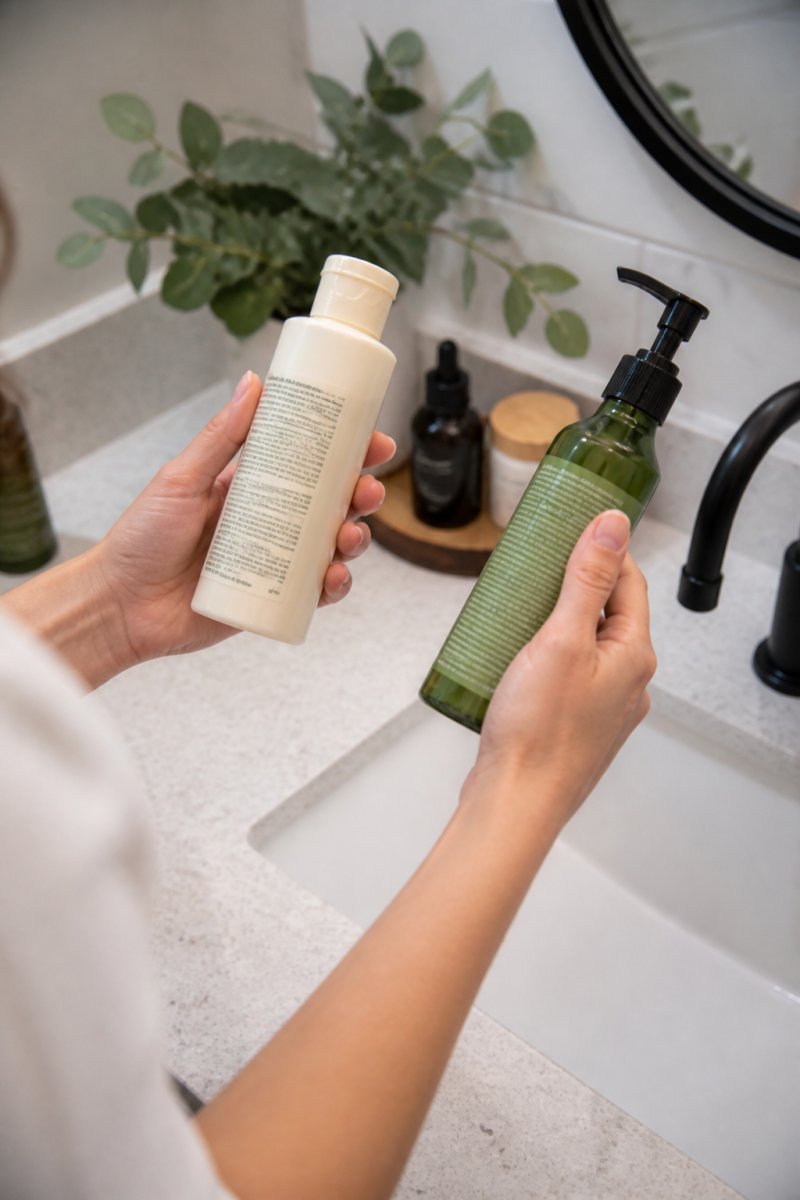
When a brand claims to be "infused with rosehip oil" or "packed with vitamin C," check where that ingredient appears in the list. Ingredients are listed from highest to lowest concentration. If the hero ingredient appears in the first five positions, it is present in meaningful quantity. If it appears after fragrance, preservatives, or colorants, it is likely present at less than one percent, enough to justify the marketing claim, but not enough to deliver the promised benefit.
A common pattern is the "marketing dose", an ingredient included at a concentration high enough to appear on the label but too low to have any functional effect. This is not illegal, but it means the front label is selling a story the ingredient list does not support.
What the FDA Does Not Regulate
Several environmental claims fall outside FDA jurisdiction entirely. Claims about recyclability, biodegradability, and carbon footprint are regulated by the FTC under its Green Guides, not by the FDA. The FDA checks ingredient safety and labeling accuracy. The FTC checks environmental marketing claims. Neither agency proactively reviews products before they reach shelves.
This regulatory gap means a product can make an environmental claim that is technically true but misleading. For example, a shampoo bottle labeled "recyclable" may be recyclable in theory, but if your local recycling facility does not accept that plastic resin, the bottle ends up in a landfill. The FTC Green Guides address this by requiring that recyclability claims be qualified when recycling facilities are not available to a substantial majority of consumers.
The Practical Label-Reading Sequence
When you pick up a beauty product, read it in this order:
- Ingredient list first, Identify the first five ingredients. These make up the bulk of the product.
- Find the hero ingredient, Locate the plant extract, oil, or active compound the front label highlights. Note its position.
- Check the certification seals, Note which certifying body issued each seal and what it covers.
- Read the front label last, Treat marketing claims as hypotheses to test against the ingredient list, not as facts.
The Limits of Ingredient Reading
Reading the ingredient list tells you what is in the product, but it does not tell you where those ingredients came from or how they were harvested. A product can list "palm oil" without revealing whether it came from deforested land or a certified sustainable plantation. The ingredient list is necessary but not sufficient for identifying genuine green marketing. Combine it with certification verification and brand research to close those gaps.
The Missing Angle: Ingredient Toxicity vs. Sustainability
Most discussions of green beauty treat "natural" and "sustainable" as synonyms. They are not. A naturally derived ingredient can be harvested unsustainably, while a synthetic ingredient can have a smaller environmental footprint than its natural counterpart.
The environmental impact of a cosmetic includes raw material extraction, manufacturing energy, transportation, packaging, use, and disposal. A product in a glass jar with a metal lid may have a higher manufacturing footprint than one in lightweight recycled plastic, yet consumers often assume glass is automatically greener.
Some natural ingredients, such as certain essential oils, can cause skin irritation or allergic reactions. A product can be fully sustainable in its sourcing and packaging while being problematic for sensitive skin. Evaluate environmental claims and ingredient safety as separate concerns.
Your Green Beauty Shopping Checklist
Use this checklist the next time you evaluate a beauty product claiming environmental benefits.
| Check | What to Look For | Red Flag |
|---|---|---|
| Specific claim | Named ingredient, named source, named process | Vague terms like "eco-friendly" |
| Certification | Third-party seal matching the claim | Unverifiable or missing certification |
| Ingredient list | Highlighted ingredients appear early in list | Hero ingredient listed near the end |
| Packaging | Recyclability claims match local facilities | Overpackaged "sustainable" product |
| Brand history | Consistent environmental messaging over time | Recent pivot with no track record |
Work through these checks in order. Start with the specific claim, verify the certification, then examine the ingredient list. This sequence takes about two minutes per product once you practice it.
Conclusion: Trust Your Eyes, Not the Slogans
Identifying green marketing in beauty products comes down to a single habit: verify before you trust. The brands that make specific, certified, verifiable claims are the ones doing real environmental work. Those that rely on vague adjectives and beautiful packaging are asking you to fill in the gaps with your own hope. At All-Natural Healing Store, every product we carry is personally vetted by Dr. House, also known as Dr. Holistic, with 30 years of experience in the environmentally safe health and nutrition industry. Get started with All-Natural Healing Store and build a routine you can feel good about, inside and out. And if your wellness routine extends beyond skincare to a good night's rest, consider the Dr. Holistic's Nasal Clip for Sleep Apnea, which supports easier nasal breathing by clearing mucous from the nasal passages and nasopharynx.
Frequently Asked Questions
What is the difference between 'natural' and 'organic' in beauty marketing?
'Natural' is not a regulated term on cosmetic labels, so it can mean almost anything. 'Organic' is a legally defined term, but only when the product carries a USDA Organic seal. A product can be mostly natural with some synthetic chemicals and still be marketed as 'natural.' Green marketing that is honest will use precise terms and explain what they mean. If a label is vague, it is often a sign of greenwashing.
How does the FTC regulate environmental marketing claims?
The FTC enforces the Green Guides, which explain how to avoid making misleading environmental claims. The Guides state that marketing claims must be specific and qualified. A label saying 'eco-friendly' without explaining what makes it so is too vague to be compliant. The FTC can take action against companies making deceptive claims, but it does not pre-approve labels, so shoppers need to verify claims themselves.
What are the common signs of greenwashing in the beauty industry?
Common signs include using generic terms like 'green' or 'clean' without specifics, showing nature imagery (leaves, mountains) that has no bearing on the formula, and highlighting one positive attribute while ignoring overall environmental impact. For example, a product in a non-recyclable plastic tube that claims to be 'carbon neutral' without proof. Look for specific, verifiable claims and third-party certifications instead of vague buzzwords.
How can consumers verify environmental claims on cosmetic labels?
Look for specific, verifiable claims backed by third-party certifications like USDA Organic, NSF, or Leaping Bunny. Check the brand's website for sourcing details and supply chain information. Be wary of claims that are not qualified, such as 'eco-friendly' without explaining what that means. You can also look up the brand's parent company to see its overall environmental record, which often tells a different story than the product label.
This article was written using GrandRanker


